A hands-on business course, built around the syllabus you already teach.
Student teams apply each week's lecture to a real company they build on Velofound. You choose the length, the subject, the modules, the level and how it's graded, and whether the class runs a venture market. We map it onto your syllabus, so nothing gets rewritten.
From $29 per student. Instructor accounts are free.
| Company | Value | Week |
|---|---|---|
| ByteBiteLate-night meal kits for dorms | $1.42M | ▲ 8.1% |
| StudyNestBookable quiet rooms near campus | $1.18M | ▲ 3.4% |
| LoopLaundryPickup laundry by the bag | $0.96M | ▼ 2.7% |
| ParkPalShared driveway parking | $0.88M | ▲ 5.0% |
| ThreadCycleRepairs and resale for old jackets | $0.74M | ▼ 4.2% |
Across entrepreneurship, finance and management. Mix freely.
3, 9 or 12 weeks, or stretched to fit your own calendar.
From a first course for any major to an MBA seminar.
We match modules to your weeks. You approve or swap.
You keep teaching what you teach.
Your lectures, readings, cases and exams stay as they are. Velofound is where teams apply the week's material to their own company: you lecture on pricing on Monday, and by Friday each team has priced its product and handed in the work.
- Send us your syllabus. A PDF, a Word file or a link is fine.
- We map every week to the closest module, in your order, and mark the weeks that stay lecture only. Back to you within a week.
- You approve or swap. Change any module, reorder or drop weeks, then share the join code on your first slide.
| Wk | Your topic | Velofound module |
|---|---|---|
| 2 | Opportunity recognition | Problem + market |
| 3 | Customer discovery | Customer discovery interviews |
| 5 | Business models | Solution + business model |
| 6 | Midterm | Lecture only |
| 7 | Prototyping & MVP | Build the MVP |
| 9 | Pricing | Pricing + unit economics |
| 10 | Financial projections | Financial planning |
| 12 | Legal structures | Legal + formation |
| 14 | Pitching to investors | Investor presentation + Demo Day |
The week's topic, the way you always have.
The module's hand-in, plus a role piece for each student.
With sources, and each student writes the weekly memo.
Each team reports to the class, on the schedule you set.
Grade in the gradebook or approve the agents' grades. Two clicks.
Each length ends with a working company and a pitch.
The sprint
A single unit inside a course you already teach, and the easiest way to try Velofound with a class.
- Three focused modules and one pitch
- One ready-made sprint per subject
- Fits a short or summer course
The course
The full arc, from the first problem to the investor presentation.
- Nine modules with weekly hand-ins and memos
- Earnings calls and Demo Day, if the market is on
- Our most-run length
The semester
Everything in the nine-week course, with room to go deeper.
- A second product version and real orders
- Deeper finance: break-even, cash, the raise
- A rehearsal week before Demo Day
Ready-made plans for every subject and length, or build your own.
Every module comes with a team hand-in, five role pieces so every student owns a part (CEO, CFO, CMO, COO, CTO), a rubric, a weekly memo and an AI tutor that explains and asks questions while students do the writing. A finance course can borrow Customer discovery; an entrepreneurship course can borrow Cap table + dilution.
Entrepreneurship
15 modulesFind a real problem, build the product, win the first customers and pitch the company.
- Problem + market
- Solution + business model
- Market research + competition
- Customer discovery interviews
- Build the MVP
- Legal + formation
- Marketing + sales
- Iterate + grow
- Open for business
- Problem, customers + market
- Business model + pricing
- Plan + pitch
- Scale + investor presentation
- Scale plan + rehearsal
- Investor presentation + Demo day
Finance
15 modulesHow a startup makes money, models it, values it and raises for it — and what investors see.
- Intro to venture: how startups get funded
- The company + its economics
- Cost of existing solutions + willingness to pay
- Pricing + unit economics
- Startup costs + funding need
- Revenue model + forecasting
- The financial model
- Financial planning
- Break-even + scenario analysis
- Working capital + cash management
- Cap table + dilution
- Valuation + the raise
- Reading the market: your company's price
- Financial controls + the metrics dashboard
- The investment memo + investor presentation
Management
15 modulesStrategy, the team, how the work gets done and how a leader keeps a company on course.
- Strategy + the team
- Team charter + decision rights
- Org design + roles
- Hiring + onboarding
- Operations + people
- Operating model + processes
- KPIs + the weekly scorecard
- Supply chain + vendors
- Customer service + retention
- OKRs + the 90-day plan
- Risk + change management
- Culture + leadership
- Operations + fundraising
- Execution + leadership
- The board presentation
In the ready-made nine-week plan for that subject. Swap any week.
Two settings, per course or per week.
How technical
Plain-language prompts, worked examples and pre-filled templates. One number at a time.
Real interviews, a set price, a 12-month forecast and a market size with sources.
Driver-based forecasts, sensitivity, 13-week cash, a cap table across two rounds and a full valuation.
How much time
The team hand-in only: one deliverable that applies your lecture to their company.
Plus a role piece for every student, so each person is accountable for a part.
Plus the weekly memo, earnings calls and the venture market.
Mix them: go light during exam weeks and deep during project weeks, at any level.
Things they can show, not just things they thought about.
A few of the deliverables from the nine-week entrepreneurship course. Each one is graded on quality, not on whether the box was filled.
A live website
Every word written by the team in the Velofound website builder. For classroom teams the AI drafting is switched off.
Recorded customer interviews
Two per student, found by the student, with the recording handed in, not a summary of one.
A competitor map
Direct and indirect alternatives on the two factors customers care about, and the one difference that sets the team apart.
A prototype demo
A Figma file, a video, a site or a Claude artifact, demoed live on a recorded call with the deck behind it.
An ad that actually runs
The team uploads the creative, it's reviewed for quality, then it runs day by day against a budget from the Team Bank.
A launch budget
Every startup cost with a quantity, a unit price and a source, checked against the cash the team really has.
A venture market, on your terms. Or none at all.
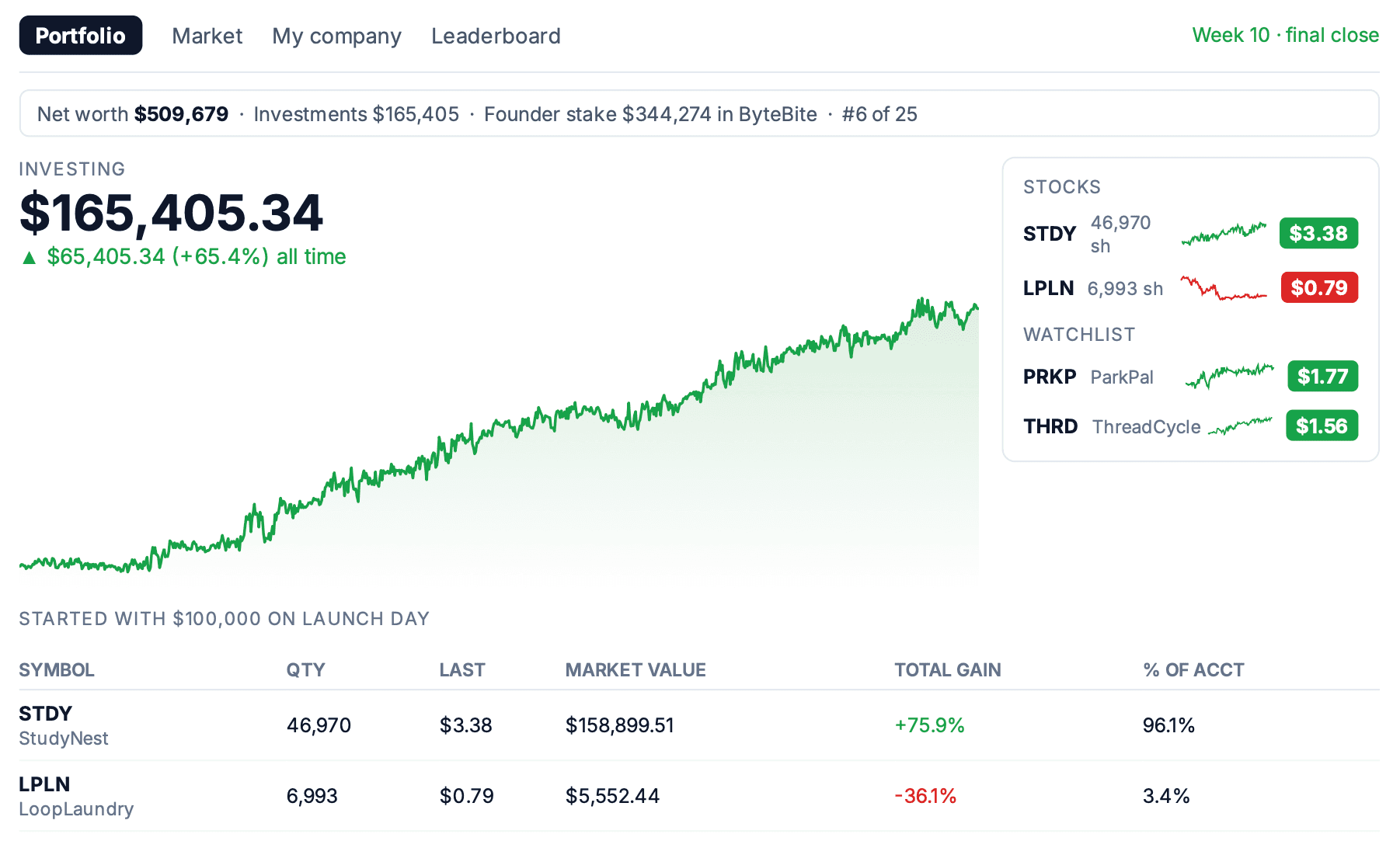
If the market is on, every student gets $100,000 of play money to invest in classmates' companies. Each share price blends three inputs, and you choose the weights. The work score is graded fresh each week and never sees the share price.
Earnings calls every week, every two weeks or every three weeks, so the market fits the class time you have.
Or switch the market off
Teams still build the company and complete every module. No prices, no trading, no leaderboard. Or start it off and turn it on once every team has something to pitch.
You grade
From the rubric, with Velofound's score shown alongside as a second opinion.
Agents grade, you approve
Velofound scores every hand-in and drafts feedback. You review the week on one screen.
Agents grade, you watch
For large sections. Handed-in work locks, so every grade is on exactly what was submitted.
Use the site itself, with its own options.
Instead of weekly modules, students use the full platform founders use, with every tool for building, launching and running a business. Each team shares one company. You get a command center with every team in one grid, plus announcements and the class roster.
- Team size, and whether students pick teams or you randomize them
- Start and end dates for the term
- Who pays: the university, the students or a course fee
- A command center with every team's progress in one grid
- Students keep their accounts after the term ends
Per student, per course. Instructor accounts are free.
One unit inside a course you already teach.
The core course, from problem to investor pitch.
The full arc, plus real orders and a rehearsal.
Velofound all semester, with the $49-a-month Growth plan included.
Who pays is up to you: one university invoice (net 30), students by card when they join, or a course materials fee. No setup or platform fees; unused seats are credited to your next course. FERPA-aligned under a signed data privacy agreement, and student work is never used to train AI.
Before you put it on the syllabus.
Do I have to change my syllabus?
What does it cost?
Who pays?
Does anyone spend real money?
Can I run it without the stock market part?
Where does AI fit in?
Is student data protected?
What do students need?
Planning the course
How it compares with a decision simulation, and what a week looks like.
Read →How to teach entrepreneurship hands-onA nine-week plan, a mapped syllabus, and assessing team work fairly.
Read →A business simulation for finance and managementTwo nine-week plans, and pitching them from intro to graduate level.
Read →Join with a course code
Six characters from your instructor. Then start the business, on your own or with your team.
Join a course →InstructorsSet up a course
Pick the format and the number of students and get the code for your first slide. Or send us your syllabus and we'll map it within seven days.
Set up a course →